 logo
logo
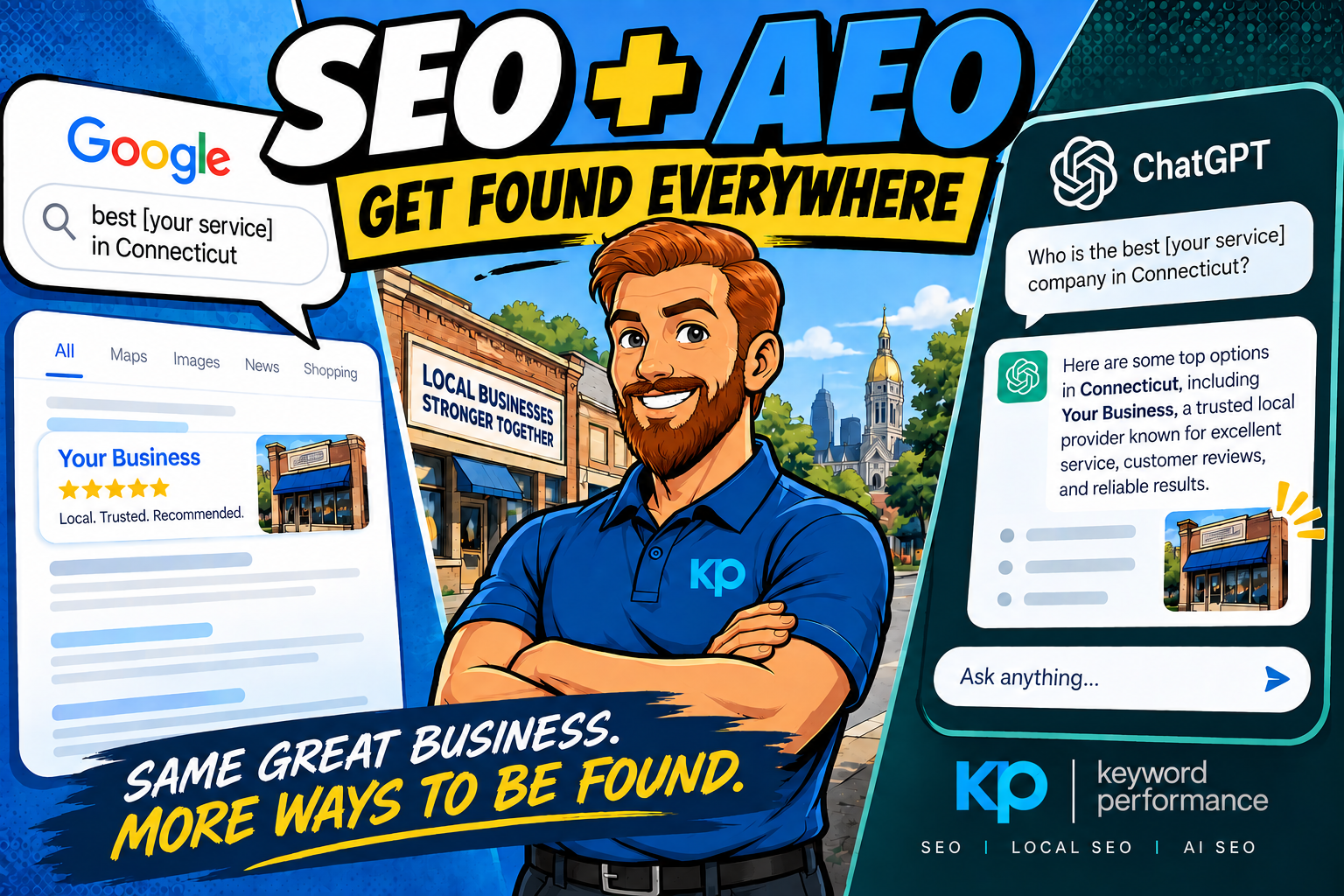
For years, getting found online primarily meant ranking well in Google.
That’s no longer the entire picture.
Customers are still using traditional search engines, but they’re also discovering businesses through AI Overviews, AI-powered search experiences, conversational assistants, and tools like ChatGPT, Gemini, Copilot, and Perplexity.
Instead of always typing a short keyword into Google and scrolling through a page of links, people can now ask detailed questions and receive an answer assembled from multiple sources.
For businesses, that creates an important new challenge:
Is your website simply optimized to rank—or is your business also positioned to become part of the answer?
That’s where Answer Engine Optimization (AEO) and AI SEO enter the picture.
We discussed the early development of this trend in our original guide to Answer Engine Optimization. Since then, AI-powered search has evolved rapidly, making it increasingly important to think beyond traditional rankings.
The good news is that businesses don’t have to choose between SEO and AEO.
The strongest digital strategies combine them.
What Is Answer Engine Optimization (AEO)?
Answer Engine Optimization is the process of structuring and improving online content so search engines and AI-powered systems can easily understand it and potentially use it when answering a user’s question.
Traditional SEO often focuses on helping a webpage rank for a search query.
AEO takes that strategy a step further by asking:
Can a search or AI platform easily understand the answer this page provides?
For example, someone might traditionally search:
“Local SEO company Connecticut”
But an AI search could be much more conversational:
“How can a Connecticut service business improve its visibility in Google Maps?”
Or:
“What’s the best way for a local business to get more leads from Google?”
Businesses that clearly answer those questions may have more opportunities to gain visibility as search becomes increasingly conversational.
What’s the Difference Between SEO, AEO and AI SEO?
These terms overlap, but they aren’t necessarily identical.
SEO (Search Engine Optimization) focuses on improving a website’s visibility in traditional organic search results.
AEO (Answer Engine Optimization) focuses on making information clear, relevant, and structured so it can effectively answer specific questions.
AI SEO takes a broader approach to visibility across AI-powered discovery experiences, including traditional search engines incorporating generative AI as well as standalone AI assistants.
An easy way to think about it is:
SEO helps your business get found.
AEO helps your content become part of the answer.
AI SEO expands your visibility across the growing AI-powered search ecosystem.
Rather than treating these as competing strategies, businesses should consider how they work together.
AEO Isn’t Replacing Traditional SEO
One of the biggest misconceptions surrounding AI search is that traditional SEO is becoming obsolete.
That’s not where search is headed.
AI-powered systems still need to discover, understand, evaluate, and retrieve information from the web.
That means many traditional SEO fundamentals remain extremely important.
Your website still needs:
- Helpful, original content
- Strong technical SEO
- Logical site architecture
- Descriptive page titles
- Internal linking
- Crawlable pages
- Mobile-friendly design
- Fast performance
- Relevant backlinks
- Clear business information
Think of traditional SEO as the foundation.
AEO and AI SEO build upon that foundation by making your information easier to understand, retrieve, summarize, and potentially reference.
That’s why our approach to AI SEO doesn’t abandon traditional search optimization. It expands upon it.
Stop Writing Only for Keywords—Start Answering Questions
Keywords still matter.
But understanding why someone is searching matters even more.
Consider a local HVAC company.
Traditional keyword research might identify phrases such as:
HVAC company Connecticut
AC repair near me
Heating contractor Connecticut
Those keywords are valuable, but they only tell part of the story.
Potential customers may actually want answers to questions such as:
How much does AC repair cost?
Should I repair or replace my air conditioner?
Why is my furnace making a strange noise?
How quickly can an HVAC company come to my home?
Those questions reveal the customer’s actual problem.
Creating useful content around those problems gives search engines, AI platforms, and—most importantly—potential customers better information.
That’s a fundamental part of modern AEO.
Give AI Something Worth Citing
This may be one of the biggest opportunities businesses overlook.
The internet doesn’t need another article that simply repeats information found on hundreds of other websites.
AI has made generic content even easier to produce.
That makes original experience and expertise more valuable, not less.
Businesses should look for opportunities to publish information that couldn’t easily be created by someone who knows nothing about their industry.
That could include:
- Original research
- First-hand observations
- Case studies
- Customer questions
- Industry expertise
- Proprietary data
- Local market insights
- Before-and-after examples
- Original photography
- Expert commentary
- Detailed processes
- Real-world results
For example, a Connecticut roofing contractor probably knows things about local homes, weather conditions, roofing materials, common problems, and customer concerns that a generic national content writer doesn’t.
That experience is valuable.
Don’t just give AI more content. Give it information worth understanding and referencing.
Structure Content So Answers Are Easy to Find
You shouldn’t write robotic content simply because you’re trying to appeal to AI.
Write for people first.
But make the information easy to understand.
For example, if your heading asks:
How Long Does SEO Take to Work?
Don’t bury the answer five paragraphs later.
Answer the question immediately and then provide additional context.
A strong structure might look like this:
Direct answer → explanation → supporting details → example → next step.
Other formatting practices can also improve readability:
- Descriptive H2 and H3 headings
- Short, focused paragraphs
- Bulleted lists where appropriate
- Comparison tables
- Clearly defined terms
- Relevant internal links
- Supporting statistics
- FAQs based on real customer questions
The goal isn’t to “trick” an AI system.
It’s to remove ambiguity.
If a person can quickly understand what you’re saying, machines generally have a better opportunity to understand the information as well.
Build Topical Authority Instead of Publishing Random Articles
One blog post about a subject doesn’t necessarily establish expertise.
That’s why modern content strategies should focus on topic depth.
For example, an HVAC company’s website might have a primary air-conditioning service page supported by articles covering:
AC repair → AC replacement → AC maintenance → AC costs → common AC problems → energy efficiency → AC FAQs
Those pages can then be connected through relevant internal links.
Together, they create a much stronger body of information than a collection of unrelated blog posts.
This approach benefits traditional SEO while also giving answer engines more context about the subjects associated with your business.
Your Website Isn’t the Only Place AI Can Learn About Your Business
This is another important change in how businesses should think about search visibility.
Your website is critical—but your overall digital presence matters too.
Information about a business can exist across:
Your website → Google Business Profile → directories → reviews → news coverage → industry websites → social profiles → third-party mentions → backlinks
Consistency across that ecosystem helps establish a clearer picture of your business.
Who are you?
What services do you provide?
Where do you operate?
What subjects are you experienced in?
What do customers say about you?
What other websites mention or reference your business?
Building that broader digital footprint has long been valuable for SEO. It takes on additional importance as businesses think about how brands and entities are understood across AI-powered discovery platforms.
Local Businesses Need AEO Too
AEO isn’t only for national brands or large publishers.
It can be especially important for local businesses.
Imagine someone asking an AI assistant:
“Who repairs commercial roofs near Hartford?”
“What type of lawyer handles a Connecticut property dispute?”
“How do I find a reputable plumber near New Haven?”
“What digital marketing company specializes in Local SEO in Connecticut?”
These searches combine questions, location, services, reputation, and intent.
That’s why local businesses should make it extremely clear:
- Where they’re located
- Which communities they serve
- What services they offer
- How customers can contact them
- When they’re open
- What makes their expertise relevant
- What customers say about them
Your website and local business profiles should reinforce one another.
A strong local SEO strategy therefore becomes an important part of preparing for AI-driven local discovery.
Reviews May Become Even More Important in AI-Powered Discovery
Reviews have always influenced customers.
They also provide machines with additional context about a business.
A strong review profile can reveal much more than an average star rating.
Customers naturally mention services, experiences, locations, employees, products, results, and problems that were solved.
For example, reviews for a contractor might repeatedly mention:
“roof replacement,” “emergency repair,” “Wallingford,” “storm damage,” or “commercial roofing.”
That creates additional context surrounding what the business does and how customers experience it.
Businesses should therefore make review generation and reputation management an ongoing part of their local marketing strategy—not a one-time campaign.
Structured Data Still Has a Role—But Don’t Chase Tricks
Schema markup and structured data can help search engines better understand specific information on webpages.
But structured data shouldn’t become an excuse to chase every new SEO tactic.
The same applies to supposed “secret” techniques designed specifically to manipulate AI systems.
Search technology will continue changing.
A more sustainable strategy is to make your website technically accessible while publishing information that is:
Useful. Accurate. Original. Clear. Current. Trustworthy.
Those principles have survived multiple generations of search technology for a reason.
Measure AI Visibility Differently
Traditional SEO has familiar metrics:
Rankings → Impressions → Clicks → Website Traffic → Leads → Sales
AI search introduces additional ways to think about visibility.
Businesses may increasingly monitor:
Brand mentions → Citations → Referenced pages → AI referral traffic → Topics → Search intent → Leads
We’re already seeing webmaster platforms introduce reporting that helps website owners understand when their pages are referenced in AI-generated experiences.
This is an important development because AI visibility isn’t always the same thing as a traditional keyword ranking.
A customer may encounter your company during an AI-generated comparison or answer before ever visiting your website.
That means businesses should continue measuring traffic and conversions while also beginning to understand how their brands appear throughout the AI-assisted discovery process.
Don’t Optimize for ChatGPT—Optimize for Your Customers
This distinction matters.
It can be tempting to ask:
“How do I rank #1 in ChatGPT?”
That’s probably the wrong question.
AI-generated answers can vary depending on the platform, query, context, available sources, freshness of information, and even how someone phrases the question.
Instead, ask:
“How can we become one of the most useful and trustworthy sources of information about what we do?”
That’s a strategy you can actually build around.
Create the best resources you can.
Demonstrate real expertise.
Keep information accurate.
Build authority throughout your industry.
Earn reviews and mentions.
Maintain strong technical SEO.
Answer the questions your customers actually ask.
Those efforts can support traditional SEO, AEO, local search, and emerging AI search visibility at the same time.
The Future of Search Isn’t SEO vs. AEO
Businesses shouldn’t have to choose between optimizing for Google and optimizing for AI.
The real goal is to build a digital presence strong enough to be discovered wherever your customers choose to search.
Traditional Google results still matter.
Google Maps matters.
Your Google Business Profile matters.
Reviews matter.
Your website matters.
Quality content matters.
And increasingly, how AI-powered systems understand and reference information about your business matters too.
That’s why modern search strategies should bring SEO, Local SEO, AEO, content, authority, and AI search optimization together.
At Keyword Performance, we’re helping businesses adapt their search strategies for both the search engines people use today and the AI-powered discovery experiences that continue to emerge.
If you’d like to take a deeper look at where AEO began, read our original article, Optimizing for the Future: Answer Engine Optimization (AEO).
And if you’re ready to start preparing your website for the next generation of search, explore our AI SEO Services.
Ready to find out how visible your business is in traditional and AI-powered search? Contact Keyword Performance to discuss an SEO + AEO strategy built around your business.
Frequently Asked Questions About SEO and AEO
What is Answer Engine Optimization (AEO)?
Answer Engine Optimization is the process of creating and structuring content so search engines and AI-powered platforms can more easily understand it and potentially use it to answer user questions. AEO emphasizes clear answers, strong topical relevance, trustworthy information, and well-organized content.
What is the difference between SEO and AEO?
SEO primarily focuses on improving visibility in organic search results. AEO focuses on making information easier for answer engines and AI-powered search systems to understand and retrieve. The two strategies overlap significantly and work best together.
Is AEO the same as AI SEO?
Not exactly. AEO primarily focuses on optimizing information to answer questions effectively. AI SEO is a broader strategy for improving brand and content visibility across AI-powered search and discovery platforms. AEO can therefore be considered an important component of a broader AI SEO strategy.
Can you optimize a website for ChatGPT and AI search?
Businesses can improve the signals that support AI-search visibility by creating original, authoritative content, answering customer questions clearly, strengthening technical SEO, building brand authority, earning relevant mentions, maintaining accurate business information, and keeping content current. However, no legitimate SEO company can guarantee that a business will appear in a particular AI-generated answer.
Will AEO replace traditional SEO?
AEO is better viewed as an expansion of SEO rather than its replacement. Websites still need strong technical foundations, crawlable content, authority, useful information, and traditional search visibility. AEO builds on those fundamentals for a search environment where users increasingly receive direct and AI-generated answers.